


Shooting Heads
(aka shooting tapers)

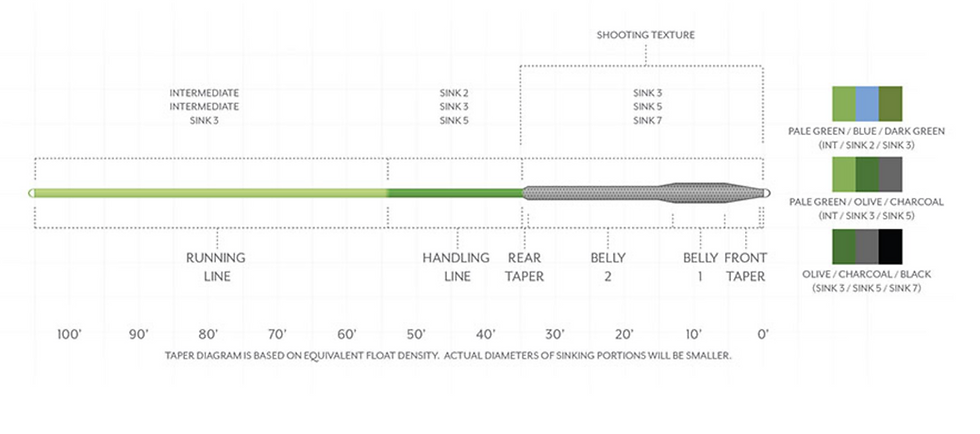
When long casts are required and casting skills are still developing, shooting heads can be an useful option. A shooting head system uses a short, heavy head (typically around 30 feet long). It does not take much casting skill to propel this type of setup a considerable distance. In many ways, it is like a brick on a string.
Two Systems
There are two shooting head systems.
The first is an integrated shooting head line, where the running line is a continuation of the shooting head itself. In other words, the fly line is manufactured as a single piece.

The second consists of a short, heavy head with a loop at the rear that is connected to a separate running line (a two-piece system). Such a setup allows the angler to carry multiple heads for different conditions—floating or sinking heads, longer or shorter heads, and so on.

When casting a shooting head, it is generally best to have no more than about two feet of running line outside the rod tip. A light running line does not have sufficient mass to control the heavy head. Because of this, shooting heads can be effective where there is very little room for a back cast.
Advantages
Anglers use shooting heads primarily because they allow very long casts and cover a large amount of water. Danish sea trout anglers, for example, commonly use shooting heads when fishing for seatrout (anadromous brown trout) from the coast. Shooting heads are also widely used for saltwater shoreline fishing in North America because of the distances that can be achieved.
They can also be useful on large lakes when searching for fish. In addition, shooting heads are well suited for turning over large, heavy flies.
Disadvantages
Integrated shooting head lines are manufactured with a running line similar to that of conventional fly lines, so they generally do not suffer from the same running-line issues found in separate shooting head systems.
When the system consists of a separate head and running line connected by loops, the choice of running line becomes very important. The thinner the running line, the less friction it encounters in the rod guides and the farther it can be cast. However, thinner running lines are also more difficult to handle. Stripping in a thin monofilament running line, for example, is no joke. Since a significant amount of running line must be kept outside the reel and readily available, tangles can become a major issue—and few things tangle as thoroughly as a very thin running line.
The thicker the running line, the greater the friction, which in turn reduces casting distance. On the other hand, thicker running lines are much easier to handle. They also tend to tangle less, especially if stretched beforehand.
As the saying goes: the one with the choices also has the problems.
Accuracy is not a strong point of shooting heads. To make another cast, all of the running line must be stripped back in. Mending the line is not possible, and roll casting is out of the question. Finally, these lines tend to land heavily on the water's surface, which is not something fish particularly appreciate.
My Opinion
(my blog, my rules)
I do not see any particular reason to use shooting heads for lake or river fishing. Given adequate casting ability, a well-designed fly line is more likely to be effective. If anything, one might argue that they are marketed as a solution for anglers with limited casting skills.
In my view, a shooting head is fundamentally a casting system rather than a fishing system. Its primary purpose is to make long casts easier, not necessarily to improve presentation, line control, mending capability, accuracy, or overall fishing effectiveness.


Comments